

Sustainability · 2025
In this section53 topics
- Sustainability Policy3 items
- Sustainability Goals & UN SDGs3 items
- Policy Review3 items
- Business Value Chain1 item
- Stakeholder Analysis1 item
- Environmental Policy & Guidelines5 items
- Environmental Policy Review3 items
- Energy — Plan & Guidelines2 items
- Energy — Electricity Consumption1 item
- Energy — Fuel Consumption1 item
- Energy — Targets2 items
- Energy — Performance & Outcomes2 items
- Water — Plan & Guidelines2 items
- Water — Withdrawal, Discharge & Consumption1 item
- Water — Targets2 items
- Water — Performance & Outcomes2 items
- Waste — Plan & Guidelines2 items
- Waste — Generation, Disposal & Recycling1 item
- Waste — Targets2 items
- Waste — Performance & Outcomes2 items
- GHG — Plan & Guidelines2 items
- GHG — Emissions1 item
- GHG — Emissions Verification1 item
- GHG — Principles & Standards1 item
- GHG — Targets1 item
- GHG Targets — Net Zero1 item
- GHG Targets — Carbon Neutrality1 item
- GHG Targets — Other Targets1 item
- GHG — Performance & Outcomes2 items
- Environmental Legal Incidents1 item
- Other Environmental Management1 item
- Social Policy & Guidelines5 items
- Social Policy Review3 items
- Social — Principles & Standards Practised1 item
- Human Rights Due Diligence2 items
- Employees — Plan & Guidelines3 items
- Employees — Workforce1 item
- Employees — Remuneration & Provident Fund1 item
- Employees — Training & Development1 item
- Employees — Occupational Health & Safety1 item
- Employees — Labour Relations1 item
- Employees — Employee Representation2 items
- Employees — Targets2 items
- Employees — Performance & Outcomes2 items
- Customers — Plan & Guidelines3 items
- Customers — Satisfaction Results1 item
- Customers — Targets2 items
- Customers — Performance & Outcomes2 items
- Community & Social — Plan & Guidelines3 items
- Community & Social — Targets2 items
- Community & Social — Performance & Outcomes2 items
- Other Social Management1 item
- Law Violation Incidents1 item
Sustainability Policy
Has a Sustainability Policy
Yes
Policy Description
Sustainability Policy and Goals
JAS Asset Public Company Limited operates a business in the development and management of shopping centers and commercial spaces, adhering to the principles of good governance, transparency, and responsibility toward stakeholders, alongside prudent management to achieve stable and sustainable long-term growth. The Company establishes its sustainability policy as a framework for the Board of Directors, executives, and employees at all levels, integrating economic, social, environmental, and corporate governance aspects into its strategies, business plans, and decision-making processes, while strictly complying with relevant laws, regulations, and requirements.
In terms of economic and corporate governance, the Company aims to generate appropriate and sustainable returns for shareholders under good corporate governance, considering factors that may impact the business in economic, social, and environmental aspects, alongside prudent and transparent decision-making. Project development and commercial space management take into account impacts on tenants, customers, business partners, and surrounding communities, while emphasizing fair service provision to tenants and customers, with clear contract management systems and complaint handling processes, as well as security measures within projects and personal data protection to build confidence among stakeholders.
In terms of social aspects, the Company respects human rights, promotes equality and non-discrimination, and does not support illegal labor, while encouraging business partners and tenants to operate responsibly. The Company focuses on employee development, along with occupational health and safety, including prioritizing the safety of customers within its projects, and conducting activities to build good relationships with surrounding communities.
In terms of environmental aspects, the Company establishes environmental management policies, focusing on efficient resource utilization, reducing impacts from energy and water consumption, and waste management, while strictly complying with relevant laws and requirements. The Company defines a framework for transparent and verifiable management of energy and greenhouse gas emissions data to support the establishment of targets and measures for reducing greenhouse gas emissions in alignment with the Group’s direction toward net zero greenhouse gas emissions.
JAS Asset promotes the adoption of technology and digital systems to enhance project management efficiency and reduce environmental impacts, while monitoring and evaluating sustainability performance and reviewing policies to align with the business context and stakeholder expectations.
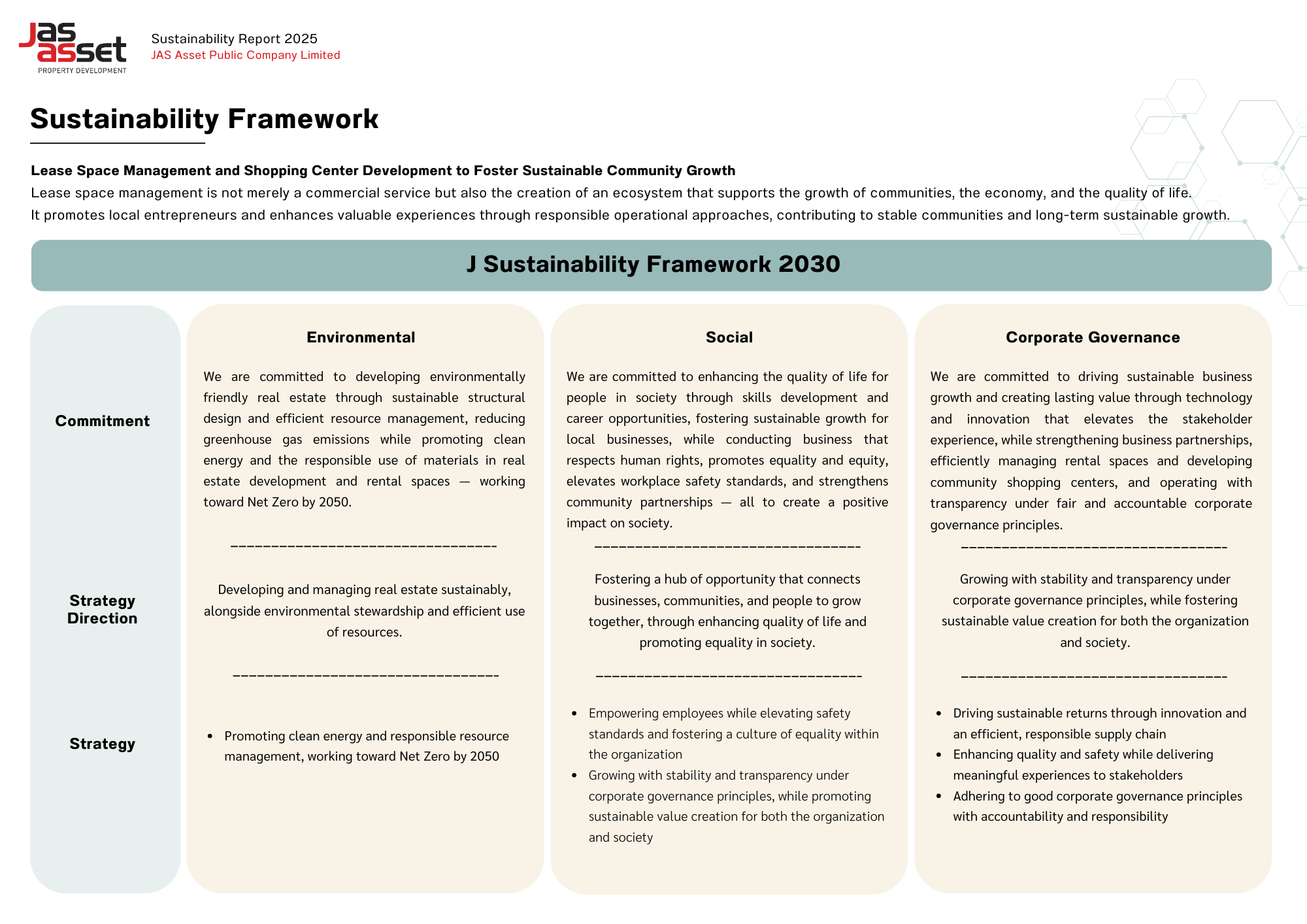
In addition, the Company is committed to creating sustainable value for all stakeholders, including shareholders, employees, business partners, and communities, to achieve mutual long-term benefits. Therefore, the Company establishes the sustainability framework as follows:
Policy Document Link
https://www.jasasset.co.th/storage/document/cg/sustainability-policy-en.pdf
Sustainability Goals & UN SDGs
Has Sustainability Goals
Yes
Goals Description
Strategic Direction: Stable and transparent growth under good corporate governance principles, while promoting sustainable value creation for the organization and society.
Enhance quality and safety while delivering valuable experiences to stakeholders.
Customer satisfaction not less than 75%.
Tenant and shop satisfaction not less than 75%.
Comply with good corporate governance principles and responsibility.
Cases of misconduct in business ethics: 0 cases (every year).
Cases of misconduct related to corruption: 0 cases (every year).
Number of complaints regarding data breaches: 0 cases (every year).
Promote clean energy and manage resources responsibly to achieve Net Zero by 2065.
Reduce water consumption per employee by 3% compared to the previous year.
Reduce purchased electricity consumption from external sources by 3% compared to the previous year.
Reduce waste generated from internal operations by 5% by 2026.
Number of environmental and biodiversity promotion projects: 1 project/year.
Achieve net zero greenhouse gas emissions by 2065.
Enhance employee capabilities while improving safety and promoting a culture of equality within the organization.
Human rights complaints: 0 cases (every year).
Employee engagement score not less than 75%.
Average training hours per employee not less than 6 hours/person/year.
Number of serious workplace accidents (fatalities): 0 cases (every year).
Stable and transparent growth under good corporate governance principles, while promoting sustainable value creation for the organization and society.
Number of community engagement projects not less than 2 projects/year.
Community satisfaction survey not less than 75%.
UN Sustainable Development Goals
| SDG Goal |
|---|
| Goal 3 Good Health and Well-being |
| Goal 4 Quality Education |
| Goal 5 Gender Equality |
| Goal 6 Clean Water and Sanitation |
| Goal 7 Affordable and Clean Energy |
| Goal 8 Decent Work and Economic Growth |
| Goal 9 Industry, Innovation and Infrastructure |
| Goal 10 Reduce Inequalities |
| Goal 11 Sustainable Cities and Communities |
| Goal 12 Responsible Consumption and Production |
| Goal 13 Climate Action |
| Goal 15 Life on Land |
| Goal 16 Peace, Justice and Strong Institutions |
Policy Review
Policy Reviewed This Year
Yes
Policy Changed This Year
Yes
Review Details
In 2025, the organization has adjusted its sustainability direction in several key dimensions as follows:
Sustainability framework: The organization has elevated its approach from setting annual strategies to a medium-term sustainability development framework called the J Sustainability Framework 2030. The main concept is to Lease Space Management and Shopping Center Development to Foster Sustainable Community Growth.
Sustainability governance structure: The organization has formally established a sustainability governance structure for the first time by dividing roles and responsibilities into three levels, from the Board of Directors, the Nomination and Remuneration Committee, to the Sustainability Working Committee, in order to ensure that policy implementation is clear and continuous at all levels of the organization.
Sustainability goals and indicators: The organization has changed from setting qualitative goals to quantitative indicators that can be practically measured, covering environmental, social, and governance dimensions, with clear separation between short-term and long-term targets. This demonstrates that the organization is moving toward more systematic reporting in accordance with international standards.
Integration of technology into the sustainability policy: The organization has clearly incorporated innovation and digital technology into the sustainability policy, aiming to apply technology to improve work processes in order to reduce environmental impacts while increasing business operational efficiency.
Business Value Chain
Value Chain Description
The value chain of JAS Asset
1. Project Planning and Development
2. Design and Construction
3. Sales and Lease Management
4. Customer Service and Care
Stakeholder Analysis
Stakeholder Analysis
| Stakeholder Type | Stakeholders | Stakeholder Expectations | Response to Expectations | Communication Activities |
|---|---|---|---|---|
| Internal stakeholders | 2899 · Description: Suppliers · 2902 · Description: Community · 2906 · Description: Tenants · 2913 · Description: Shareholders · 2921 · Description: Employees · 2923 · Description: Customers · 2928 · Description: Society · 2929 · Description: Media · 2931 · Description: Government agencies and Regulators | -Business Performance, Growth, and Responsible Investment
- Ensuring Stability for Shareholders
- Opportunity and Risk Management
- Transparent, Fair, and Good Corporate Governance Practices
- Transparent Communication and Disclosure
- Employee Development, Career Opportunities, and Growth
- Fair Compensation, Benefits, and Treatment
- Creating a Positive Work Environment that Promotes Physical and Mental Well-being
- High-Quality Products and Services with Safe Infrastructure
- Effective Complaint Management
- Environmental and Social Impacts of Business Operations
| - Reviewing Company Strategies and Goals to Ensure Fair Returns
- Evaluating Communication Methods to Help Investors and Shareholders Understand Key Issues and Company Management
- Measures for Opportunity and Risk Management
- Disclosing Transparent and Verifiable Information
- Developing Employee Development Plans and Clear Career Growth Paths
- Reviewing Employee Compensation and Benefits to Align with Company Performance and Industry Standards
- Organizing Activities or Programs to Promote Workplace Well-being
- Conducting Engagement Activities Aligned with Corporate Values
- Communicating Policies, Procedures, and Transparent Monitoring Systems
- Commitment to Continuously Developing High-Quality and Safe Products and Services at Reasonable Prices
- Enhancing After-Sales Service to Meet Stakeholder Needs
- Managing Environmental and Social Impacts of Business Operations
- Fair Procurement Process
- Communicating Anti-Bribery and Anti-Corruption Policies
- Communicating Sustainable Procurement Policies to Partners
- Building Relationships and Collaborations in Business Operations
- Meetings for Information and Feedback Exchange | 2940 · Description: Social Event · 2941 · Description: Online Communication · 2942 · Description: Internal Meeting · 2944 · Description: Annual General Meeting (AGM) · 2945 · Description: Complaint Reception |
Environmental Policy & Guidelines
Has an Environmental Policy
Yes
Policy Description
Environmental Policy
JAS Asset Public Company Limited (Public) and its subsidiaries (the Company) recognize the importance of integrating environmental responsibility principles into their operational processes systematically and sustainably. The goal is to create a corporate culture that promotes environmental conservation across all aspects of work, from operational staff to senior executives, as well as all stakeholders. This includes building awareness of environmental conservation, reducing the use of unnecessary resources, and managing resources efficiently, while emphasizing the use of renewable resources and clean energy to ensure the organization’s operations align with sustainable development goals. Additionally, the organization has initiated and supports the continuous development of processes to prevent pollution from the outset. This includes improving operational processes, managing natural resources efficiently, and reducing greenhouse gas emissions from the company's operations, in line with national greenhouse gas management guidelines. Under this environmental policy framework, the Company has also established regular evaluations and reviews of its environmental practices. This includes monitoring performance, analyzing data, and adjusting strategies to align with changing environmental conditions at both national and global levels, in order to achieve long-term sustainable development goals. This policy has been approved by the senior management, who are the highest authorities responsible for overseeing and monitoring the company’s environmental operations. It has been officially implemented with comprehensive guidelines that focus on continuous improvements to create positive impacts on the environment, society, and economy. The following approaches have been outlined:
Environmental Management Practices
1. The Company strictly complies with the regulations set by law, including local laws related to the environment, and regularly monitors and assesses compliance with these regulations to ensure compliance with the required standards.
2. The company operates its business with environmental and social responsibility through the management of natural resources and waste, adhering to the principles of the Circular Economy to increase the efficiency of resource use, reduce waste, and reuse materials as much as possible, while also using technology and innovation to improve the production and management processes to minimize the impact on the environment and surrounding communities.
3. The Company shall take measures to prevent and reduce negative impacts from the Company's and its partners' operations that may arise from production, procurement and service activities, both on the Company's and its partners' part, in order to preserve the environment, communities and public health by setting environmentally friendly operating standards and supporting the use of sustainable technologies.
4. The Company supports the creation of environmental awareness by organizing training, public relations and providing environmental knowledge to employees and stakeholders to prevent possible negative impacts on the environment and create a sustainable society.
5. The Company is committed to transparently disclosing information about its operations related to natural resource and environmental management, presenting both success and factual information, and reporting progress and performance to all stakeholders through various channels, such as the annual sustainability report.
6. This policy shall be enforced on the Company and disseminated to the public for stakeholders to be aware of. Compliance with the policy shall be measured and verified by internal departments and/or external independent departments. The Company considers compliance with this policy to be the duty and responsibility of all levels of employees, including key business partners, who must strictly comply in order to create sustainability both at the corporate level and for society at large.
Policy Document Link
https://hub.optiwise.io/storage/41/sustainability-report/2024/sd-report-2024-en.pdf
Page Number in Report
60
Environmental Guidelines
| Guideline |
|---|
| Electricity Management |
| Fuel Management |
| Renewable/Clean Energy Management |
| Water Management |
| Waste Management |
| Biodiversity Management |
| Greenhouse Gas and Climate Change Management |
Environmental Policy Review
Policy Reviewed This Year
Yes
Review Details
Environmental Performance
The Company continuously carries out environmental management initiatives, focusing on issues aligned with its business nature in real estate development and the management of commercial projects and rental spaces. These operations are associated with building energy consumption, water resource management, and waste management from operational activities and common areas.
Amid a challenging business environment, the Company aims to improve energy efficiency, appropriately manage resource consumption, and further develop a more comprehensive and systematic environmental data management system. These efforts support operational stability and long-term cost management.
In 2025, the Company achieved key environmental performance outcomes in the following areas:
Energy Management
The Company places importance on energy management, as its business operations in the development and management of shopping centers and rental spaces rely primarily on electricity consumption within buildings, including air-conditioning systems, lighting systems, and common utility systems. Effective energy management is therefore essential not only for controlling operational costs but also for reducing environmental impacts.
In 2025, the Company’s total electricity consumption across the organization was 34,715,108.7 kilowatt-hours (kWh). Of this amount, 31,553,445.2 kWh or 90.89% was electricity purchased from external sources, while 3,161,663.5 kWh, or 9.11%, was generated from clean energy (Solar Rooftop). This proportion of clean energy usage reflects the Company’s approach to gradually increasing the use of alternative energy and reducing reliance on conventional electricity sources.
The Company has implemented Solar Rooftop installation projects in 6 out of 8 shopping centers. In 2025, the solar energy systems generated 3,161,663.50 kWh of electricity from solar power.
Alongside increasing the share of clean energy, the Company has continuously implemented measures to improve energy efficiency in buildings, such as optimizing air-conditioning system operations according to usage periods, upgrading lighting systems, establishing measures to turn off electrical equipment when not in use, and regularly monitoring electricity consumption data for each project to assess trends and improve energy efficiency on an ongoing basis.
These approaches support long-term energy cost management, enhance operational stability, and contribute to reducing the Company’s environmental impacts in alignment with the Group’s sustainable development direction.
Water Management
The Company recognizes that water is an important resource that must be managed appropriately. Given the nature of its business in the development and management of shopping centers and rental spaces, water is primarily used in common areas, sanitation systems, and support activities for tenants and visitors. Water management therefore focuses on efficient resource utilization, reducing unnecessary losses, and controlling water use efficiency in each project in line with its operational characteristics.
In 2025, the Company’s total municipal water consumption from 8 shopping centers was 409,545 cubic meters, with the majority of water usage occurring in common areas and service operations within the shopping centers. The Company regularly monitors water consumption data for each project to assess trends and continuously improve management efficiency.
The Company has implemented systematic water management measures, such as inspecting and maintaining building plumbing systems to reduce leakage, controlling water pressure appropriately, installing water-saving sanitary fixtures in common areas, and raising awareness of responsible water usage among employees and tenants through communication and campaign activities within the shopping centers.
These approaches support the management of utility costs, improve resource efficiency, and contribute to reducing the Company’s environmental impacts in alignment with the Group’s sustainable business practices.
Waste Management
The Company places importance on waste management arising from shopping center operations. Most waste is generated from activities in common areas, retail stores, restaurants, and visitors. Although the Company does not directly engage in manufacturing processes, the volume of waste is related to the size of each project and the number of visitors in each area. Therefore, systematic waste management is essential for cost control, efficient resource utilization, and reducing environmental impacts.
In 2025, the total amount of waste generated from the 8 shopping centers was 1,811.40 tons. The Company collects, separates, and manages waste in collaboration with legally authorized waste management service providers to ensure that the process is conducted properly, transparently, and in a verifiable manner.
The Company has implemented systematic waste management measures, such as establishing waste separation points within shopping centers, separating general waste, recyclable waste, and organic waste from restaurants, and controlling temporary storage areas in accordance with sanitary standards. In addition, the Company promotes waste reduction at the source by raising awareness among employees, tenants, and visitors to properly separate waste and encouraging the recovery and reuse of resources.
The Company also regularly monitors waste generation data from each project in order to analyze trends and continuously develop measures to reduce waste volumes. These approaches enhance resource efficiency, reduce the burden on waste disposal systems, and support business operations in alignment with the Company’s sustainable development principles.
Greenhouse Gas Emissions Management
The Company places importance on greenhouse gas emissions management arising from its shopping center operations. Electricity consumption in common areas, air-conditioning systems, lighting systems, and service support systems constitutes the primary energy use. Therefore, the Company’s greenhouse gas emission sources are mainly related to electricity consumption and certain supporting activities, rather than direct emissions from industrial production processes.
In 2025, the Company is in the process of developing a system for collecting and compiling data on energy consumption and related activities to serve as a database for preparing the organization’s greenhouse gas inventory. The Company will designate a base year once the organization achieves an appropriate level of data readiness, completeness, and reliability in its management system, ensuring that monitoring and evaluation can be conducted transparently and in a verifiable manner.
At the same time, the Company has continuously implemented energy efficiency measures, such as upgrading electrical and air-conditioning systems within shopping centers, controlling energy consumption in common areas, and installing solar power generation systems in certain projects to increase the share of clean energy and gradually reduce reliance on conventional energy sources.
To support systematic greenhouse gas management, the Company aligns its operations with the Group’s direction toward achieving Net Zero Emissions by 2050, prioritizing emission reductions from operational activities and continuously developing approaches that are appropriate to the nature of its business, in order to support sustainable long-term growth.
“Impacts, Risks, and Opportunities from Climate Change”
Although the Company does not operate a business with high levels of direct greenhouse gas emissions, the operation of shopping centers and commercial spaces requires substantial and continuous electricity consumption. In addition, the business relies on local infrastructure such as electricity systems, water supply systems, and accessibility for customers. Therefore, climate change—such as extreme weather events or increasingly stringent environmental regulations—may directly affect project operations, business continuity, and the Company’s revenue in the short, medium, and long term.
Physical Impact Dimension:Extreme weather events such as floods, storms, or heatwaves may affect shopping centers, rental spaces, and building infrastructure, potentially disrupting normal operations and resulting in additional expenses for repairing assets or utility systems. Furthermore, if projects are located in areas with recurring climate risks, it may affect the confidence of tenants and visitors as well as the long-term attractiveness of the location. This could in turn impact rental income, cash flow, and the Company’s asset value.
Nevertheless, incorporating climate risk considerations into project design and development—such as implementing efficient drainage systems, installing backup power systems, and establishing business continuity management plans—can enhance the resilience of the projects, reduce potential damage, and support the Company’s long-term financial stability.
Transition to a Low-Carbon Economy Dimension:The introduction of stricter climate-related laws and measures, including requirements on energy efficiency and disclosures aligned with international standards, may increase costs related to asset upgrades, data collection, and risk management. In addition, if shopping centers are unable to improve energy efficiency in line with the expectations of tenants and consumers, it may affect competitiveness and occupancy rates.
However, improving energy efficiency, installing renewable energy systems within projects, and integrating climate-related considerations into the enterprise risk management framework can help reduce long-term energy costs, enhance the attractiveness of projects to tenants and investors who prioritize ESG, and support the preservation of asset value in the transition toward a low-carbon economy.
“Promoting Environmental Knowledge and Capacity Building for Employees”
The Company places importance on enhancing employees’ knowledge of environmental and sustainability issues in order to strengthen their understanding of Environmental, Social, and Governance (ESG) principles and support responsible business operations.
In 2025, the Company implemented the ESG DNA Program, a sustainability knowledge initiative for employees in collaboration with the Stock Exchange of Thailand (SET). Employees were required to complete two foundational courses on business sustainability, with a target that at least 50% of participants successfully complete both courses. The results showed that 100% of employees completed both courses, reflecting strong participation and sustainability awareness among personnel across the organization.
The Company promotes knowledge development through various channels, including internal training programs, dissemination of information through the ESG Newsletter, and communication via the Company’s online sustainability platform. In addition, specialized ESG training courses are organized to help employees better understand key issues such as climate change, efficient resource utilization, and governance principles related to business operations.
These initiatives help foster a corporate culture that emphasizes environmental responsibility and support the practical integration of sustainability principles into daily work processes.
Policies & Guidelines Changed
| Change |
|---|
| Electricity Management |
| Fuel Management |
| Renewable/Clean Energy Management |
| Water Management |
| Waste Management |
| Biodiversity Management |
| Greenhouse Gas and Climate Change Management |
Energy — Plan & Guidelines
Has an Energy Management Plan
Yes
Plan Description
Energy Management
Energy management is a key factor affecting the success and sustainability of JAS Asset Public Company Limited, as energy consumption in the Company’s business operations is closely linked to environmental conservation and the mitigation of climate change impacts. The Company therefore places importance on efficient energy use to support sustainable development goals and reduce greenhouse gas emissions that contribute to global warming. In the Company’s operations, energy usage covers electricity systems for managing rental spaces in shopping centers, lighting systems, air conditioning systems, elevators and escalators, as well as fuel energy used for transportation. Such energy consumption not only affects the Company’s operating costs but also impacts business continuity. In the event of an energy crisis, such as shortages of electricity or fuel, the Company may be unable to effectively manage rental spaces.
For this reason, the Company has established clear plans and measures for energy management, such as improving electrical systems and equipment to enhance energy efficiency, adopting renewable energy, and supporting projects focused on energy conservation and the reduction of greenhouse gas emissions. In addition, the Company aims to foster awareness within the organization so that all employees recognize the importance of efficient energy use and participate in environmental stewardship. Effective energy management not only helps reduce operating costs but also enhances the Company’s image as an organization that cares about society and the environment, which serves as a key foundation for long-term sustainability and stability.
Energy Management Approach
JAS Asset Public Company Limited has established energy management approaches focusing on improving energy efficiency in buildings and utility systems, adopting energy-saving technologies and equipment, managing energy consumption in alignment with actual usage periods, promoting the use of clean and environmentally friendly energy, and raising awareness of energy conservation among employees, tenants, and stakeholders. These efforts support sustainable business operations and align with the organization’s long-term environmental development direction.
The Company has set clear targets and indicators for reducing externally purchased energy consumption and regularly monitors performance. The target is to reduce externally purchased electricity consumption by 3 percent compared to the previous year. However, as the energy consumption data of JAS Asset in 2025 represents aggregated data from all 8 shopping centers, it cannot be separated into the portions attributable to the Company’s operations and tenants, resulting in inefficiency in comparing the data with the original target.
Therefore, the Company has adjusted its measurement and monitoring approach from 2026 onwards by defining the key performance indicator as energy consumption per unit of area (square meter), in order to align with the context of community shopping center operations and more appropriately reflect energy efficiency and resource utilization.
Energy — Electricity Consumption
Electricity Consumption
| Metric | Current Year | Previous Year | Two Years Ago | Remark |
|---|---|---|---|---|
| Total electricity consumption within the organization (Kilowatt-Hours) | 34,715,108.7 | 13,499,532.24 | 12,094,140 | |
| Electricity purchased for consumption from non-renewable energy sources (Kilowatt-Hours) | 31,553,445.2 | 11,872,000 | 11,531,480 | |
| Electricity purchased or generated for consumption from renewable energy sources (Kilowatt-Hours) | 3,161,663.5 | 1,627,532.24 | 562,660 | Note: The energy consumption data is derived from the consolidated utility bills of all 8 shopping center branches; therefore, it cannot be separated into the portions attributable specifically to the Company and the office. As a result, the performance cannot be compared with the original target. The Company has therefore adjusted its measurement approach in 2026 to resource consumption per unit of area (square meter) in order to align with the business context of JAS Asset. |
Energy — Fuel Consumption
Fuel Consumption
| Metric | Current Year | Previous Year | Two Years Ago |
|---|---|---|---|
| Jet fuel (Litres) | |||
| Diesel (Litres) | 12,148.61 | 836.72 | 867.03 |
| Gasoline (Litres) | 10,527.84 | 3,899.13 | 1,433.3 |
| Fuel oil (Litres) | |||
| Crude oil (Barrels) | |||
| Natural gas (Standard cubic feet) | |||
| LPG (Kilograms) | |||
| Steam (Metric tonnes) | |||
| Coal (Metric tonnes) |
Energy — Targets
Has Set Targets
Yes
Targets
| Target | Base Year | Base Year Value | Target Year | Target Change (%) | Unit |
|---|---|---|---|---|---|
| Reduction of electricity purchased for consumption | 2,025 | 31,553,445.2 | 2,026 | 3 | Megawatt-Hours |
Energy — Performance & Outcomes
Has Performance Results
Yes
Performance Description
Energy Management Performance in 2025
Installation of Solar Rooftop to reduce electricity costs and greenhouse gas emissions
To achieve the goal of reducing greenhouse gas emissions, the Company has installed solar cell systems under a Private PPA or “Private Power Purchase Agreement,” which is an agreement for purchasing electricity generated from solar energy. The installation and power purchase agreement are carried out by JGS Synergy Power Company Limited, a company within the Jaymart Group that operates in renewable energy with comprehensive services. In 2025, solar cell systems under the Private PPA model have been installed in a total of 6 branches out of 8 branches, namely:
The Jas Wanghin
Jas Village Amata
Jas Green Village Kubon
Jas Green Village Bang Bua Thong
Jas Green Village Prawet
Jas Green Village Ramkhamhaeng
In 2025, the Company purchased electricity from JGS Synergy Power Company Limited totaling 3,161,663.50 kWh,
amounting to 9,747,651.44 Baht, which helped reduce greenhouse gas emissions by 1,480.29 tCO2eq.
Energy Consumption Management
The Company has a policy focusing on efficient energy use to reduce environmental impacts and climate change. The operational approach includes increasing the use of electricity from renewable natural sources and improving energy efficiency. In 2025, the Company’s energy consumption covered the headquarters building area, with energy sourced from 2 types: non-renewable energy sources and renewable natural energy sources, as follows:
From non-renewable energy sources
The electricity used by the Company from direct sources in 2025 was purchased from the Metropolitan Electricity Authority, totaling 31,553,445.2 kilowatt-hours, or accounting for 90.89 percent of the total energy used by the Company at the headquarters. This energy was used for core operations such as air conditioning systems, lighting systems, and activities within the shopping centers including tenants.
From renewable natural energy sources
The Company is committed to utilizing renewable energy for electricity generation, starting with the installation of Solar Rooftop panels on shopping center rooftops under the Private PPA or “Private Power Purchase Agreement” model, installed by JGS Synergy Power Company Limited, a Jaymart Group company engaged in renewable energy and comprehensive services.
In 2025, electricity generated from renewable natural energy sources, or Solar Rooftop systems, from 6 shopping centers totaled 3,161,663.5 kilowatt-hours, accounting for 9.11 percent of the total electricity consumption of the Company. This reflects the Company’s intention to increase the share of clean energy, reduce reliance on external energy sources, and continuously support the organization’s sustainability goals.
Performance Results: In 2025, the total electricity consumption was 34,715,108.7 kilowatt-hours.
Divided into electricity consumption from external sources of 31,553,445.2 kilowatt-hours, accounting for 90.89 percent.
Electricity consumption from clean energy, or Solar Rooftop, of 3,161,663.5 kilowatt-hours, accounting for 9.11 percent.
*Data includes all tenants across 8 branches.
Water — Plan & Guidelines
Has a Water Management Plan
Yes
Plan Description
Water Management Plan
JAS Asset Public Company Limited is committed to promoting efficient and responsible water use among employees within the organization and tenants within shopping centers, in order to reduce water loss from unnecessary usage and ensure that available water resources are utilized to their maximum benefit. The Company conducts regular inspection and maintenance of water-related equipment to ensure that such equipment is in proper working condition, reduce the risk of leakage or water loss from damaged equipment, and monitor and control the quality of wastewater generated from business operations to comply with legally required standards before discharging it outside the buildings, ensuring that the discharged wastewater does not cause impacts on the environment, communities, and society.
This includes communication and building understanding of efficient water usage among operators, as well as the continuous development and improvement of water management systems. The Company also promotes awareness of water conservation among employees through regular campaigns and internal communication activities.
Water — Withdrawal, Discharge & Consumption
Water Withdrawal, Discharge & Consumption
| Metric | Current Year | Previous Year | Two Years Ago | Remark |
|---|---|---|---|---|
| Total water withdrawal (Cubic meters) | 409,545 | 111,109 | 40,957 | Note: Water consumption data is taken from the combined bills of all 8 mall branches. Therefore, it is not possible to separate the data for water usage specific to the company and office portions. As a result, the performance cannot be compared against the original targets. The company has therefore adjusted its measurement approach in 2026 to water resource consumption per area (square meters). In order to align with the business context of JAS Asset. |
| Total water withdrawal by third-party water (Cubic meters) | ||||
| Total water withdrawal by surface water (Cubic meters) | ||||
| Total water withdrawal by groundwater (Cubic meters) | ||||
| Total water withdrawal by seawater (Cubic meters) | ||||
| Total water withdrawal by produced water (Cubic meters) | ||||
| Percentage of wastewater treated before discharge (%) | ||||
| Total water discharge (Cubic meters) | ||||
| Total water discharge to third-party water (Cubic meters) | ||||
| Total water discharge to surface water (Cubic meters) | ||||
| Total water discharge to groundwater (Cubic meters) | ||||
| Total water discharge to seawater (Cubic meters) | ||||
| Total water consumption (Cubic meters) | 409,545 | 111,109 | 40,957 | |
| Recycled water (Cubic meters) |
Water — Targets
Has Set Targets
Yes
Targets
| Target | Base Year | Base Year Value | Target Year | Target Change (%) | Unit |
|---|---|---|---|---|---|
| Reduction of water withdrawal | 2,025 | 409,545 | 2,026 | 3 | Cubic meters |
Water — Performance & Outcomes
Has Performance Results
Yes
Performance Description
Water Management Operations in 2025
The company's business operations, which focus on developing and managing community malls, mean that the organization's water usage is primarily related to service activities within the mall areas, such as sanitation systems, restaurant areas, building cleaning systems, and green area maintenance. The company recognizes that water is an essential resource for the economy, communities, and the environment, and therefore places importance on efficient and sustainable water management.
To make water resource management tangible, the organization has set corporate-level water reduction targets, focusing on reducing water consumption per employee, namely reducing water usage by 3% compared to the previous year. However, since JAS Asset's water consumption data is derived from the combined water bills of all 8 mall branches, it is not possible to separate the water usage data specifically for the company's operations and offices. As a result, the data cannot be effectively compared against the original targets.
Therefore, the company has adjusted its measurement and monitoring approach starting from 2026 onwards, by setting the indicator as the rate of water resource consumption per area (square meters), in order to align with the context of community mall business operations and to more appropriately reflect resource use efficiency. The results of water usage performance and progress toward targets will be reported to the Nomination, Remuneration, Corporate Governance, and Sustainability Development Committee for the purposes of oversight, monitoring, and consideration of approaches to continuously improve water resource management in alignment with the organization's sustainability policy.
Building Water Conservation Awareness Within the Organization
The company places importance on promoting and instilling a sense of water conservation awareness among employees, focusing on efficient water use for maximum benefit. The company has carried out communications through various channels within the mall, and has installed campaign signage to encourage and raise awareness about water-saving practices, particularly in areas with frequent water use such as restrooms, hand-washing basins, and dishwashing areas, so that employees can participate in reducing water usage and collectively conserve water resources sustainably.
Performance Results: In 2025, total water consumption amounted to 409,545 cubic meters (water consumption data is taken from the combined bills of all 8 mall branches).
Waste — Plan & Guidelines
Has a Waste Management Plan
Yes
Plan Description
Waste Management Plan
The company recognizes the importance of waste management, not only among operators within the group, but also extending to the surrounding communities, in order to comprehensively prevent negative impacts that may arise from business activities. This management has been integrated into the ESG dimensions (Environmental, Social, and Governance) to ensure that the organization does not violate the rights of any stakeholder group, and to prevent waste management issues that may arise from business processes. The company is committed to reducing impacts on nature, the environment, and global warming issues through sustainable waste management approaches, by establishing systematic waste and refuse management guidelines throughout the value chain. The focus is on reducing waste at the source, promoting waste segregation within mall areas and offices, increasing the proportion of reuse and recycling, as well as proper waste disposal through collaboration with tenants, waste collection and disposal service providers, as well as building awareness among employees and stakeholders, in order to elevate resource use efficiency, reduce environmental impacts, and support the organization's long-term sustainable business operation goals.
Waste — Generation, Disposal & Recycling
Waste Generation, Disposal & Recycling
| Metric | Current Year | Previous Year | Two Years Ago | Remark |
|---|---|---|---|---|
| Total waste generated (Kilograms) | 1,811,400 | 191,195 | 10,800 | Note: Waste and refuse volume data is aggregated from all 8 mall branches. It is not possible to separate the data specific to the company and office portions. As a result, the performance cannot be compared against the original targets. The company has therefore adjusted its measurement approach in 2026 to resource consumption per area (square meters). In order to align with the business context of JAS Asset. |
| Non-hazardous waste (Kilograms) | 1,811,400 | 191,195 | 10,800 | |
| Non-hazardous waste - Landfilling (Kilograms) | 1,811,400 | 191,195 | ||
| Non-hazardous waste - Incineration (with energy recovery) (Kilograms) | ||||
| Non-hazardous waste - Incineration (without energy recovery) (Kilograms) | ||||
| Non-hazardous waste - Other disposal operations (Kilograms) | ||||
| Hazardous waste (Kilograms) | ||||
| Hazardous waste - Landfilling (Kilograms) | ||||
| Hazardous waste - Incineration (with energy recovery) (Kilograms) | ||||
| Hazardous waste - Incineration (without energy recovery) (Kilograms) | ||||
| Hazardous waste - Other disposal operations (Kilograms) | ||||
| Total reused/recycled waste (Kilograms) | 0 | 3,187.5 | 153.2 | |
| Reused/Recycled non-hazardous waste (Kilograms) | ||||
| Reused non-hazardous waste (Kilograms) | ||||
| Recycled non-hazardous waste (Kilograms) | ||||
| Reused/Recycled hazardous waste (Kilograms) | ||||
| Reused hazardous waste (Kilograms) | ||||
| Recycled hazardous waste (Kilograms) |
Waste — Targets
Has Set Targets
Yes
Targets
| Waste Type | Disposal Approach | Target | Base Year | Base Year Value | Target Year | Target Change (%) | Unit |
|---|---|---|---|---|---|---|---|
| Non-hazardous waste | 2758 · Description: Reuse · 2759 · Description: Recycle · 2760 · Description: Landfilling | Reduce waste volume | 2,025 | 1,811,400 | 2,026 | 5 | Kilograms |
Waste — Performance & Outcomes
Has Performance Results
Yes
Performance Description
Waste and Refuse Management Operations in 2025
Given the nature of the community mall development and management business, the waste generated is mostly from activities within the mall buildings and service areas, such as general waste, organic waste from restaurants, recyclable waste from shops and offices, as well as waste from building maintenance. The organization recognizes the impact of waste on the environment and surrounding communities, and has therefore established waste management guidelines focusing on reducing waste at the source, promoting waste segregation by type, increasing the rate of reuse and recycling, as well as controlling waste collection and disposal in compliance with legal requirements and sanitation standards.
This also includes placing importance on collaboration with tenants, waste collection and disposal service providers, as well as building awareness among employees and stakeholders, in order to elevate resource use efficiency, reduce environmental impacts, and support long-term sustainable business operation goals.
Furthermore, the organization has set a target to reduce the volume of waste generated from internal operations by 5% by 2026 compared to the base year of 2023. Since the waste and refuse volume data of JAS Asset for the 2025 fiscal year is aggregated data from all 8 mall branches, it is not possible to separate the data specific to the company's and office operations. As a result, the data cannot be effectively compared against the original targets.
Therefore, the company has adjusted its measurement and monitoring approach starting from 2026 onwards, by setting the indicator as the rate of resource consumption and waste generation per area (square meters), in order to align with the context of community mall business operations and to more appropriately reflect resource use efficiency and waste management.
Campaigns Through Education and Awareness Building Both Inside and Outside the Organization
JAS Asset continuously promotes environmental management through educational campaigns and awareness building both inside and outside the organization, by carrying out various activities and projects to encourage efficient resource use behaviors, proper waste segregation, and the participation of employees, tenants, and stakeholders in sustainably reducing environmental impacts.
Implementation of the "Dispose Old Bras, Transform Bras into Clean Energy" Project
JAS Asset, in collaboration with Sabina, under the "New Life BRA CYCLE — Dispose and Where Does It Go?" project, promotes the proper management of old and deteriorated undergarments by putting them through a process of conversion into clean energy, helping to reduce waste volume and support sustainable environmental conservation, while also creating social value. Every single disposal of undergarments is equivalent to donating one new undergarment to foundations and charitable organizations to support those in need. The company has set up disposal points at 3 branches, namely JAS Green Village Khu Bon, JAS Green Village Ramkhamhaeng, and The JAS Ram Inthra, to provide convenience for customers and the public to participate in reducing waste and promoting a circular economy in society.
As for the project's performance results to date, JAS Asset has collected and sent 39.2 kilograms of old undergarments into the clean energy production process.
GHG — Plan & Guidelines
Has a GHG Management Plan
Yes
Plan Description
Greenhouse Gas Emissions Management Plan
The company places importance on managing greenhouse gas emissions from mall business operations, which primarily involve the use of electrical energy in common areas, air conditioning systems, lighting systems, and service support systems. The company's sources of greenhouse gas emissions are therefore related to electrical energy consumption and certain supporting activities, with no direct emissions from industrial production processes. In 2025, the company is in the process of developing a system for collecting and compiling energy data and related activities, to serve as a database for preparing a corporate-level greenhouse gas inventory, and will designate a base year when the organization has sufficient data readiness, completeness, and reliability of the management system at an appropriate level, so that monitoring and evaluation can be conducted transparently and verifiably. In parallel, the company has continuously implemented energy efficiency improvement measures, such as upgrading electrical and air conditioning systems in mall areas, controlling energy consumption in common areas, and installing solar power generation systems in certain projects, in order to increase the proportion of clean energy use and reduce reliance on conventional energy sources. To support systematic greenhouse gas emissions management, the company operates in alignment with the group's direction toward achieving Net Zero Emissions by 2050, prioritizing the reduction of emissions from operations first, and continuously developing approaches appropriate to the company's business characteristics, in order to support long-term sustainable growth.
Targets and Performance Monitoring
These are set to align with the direction of sustainability operations and approaches to mitigating climate change impacts, within the company's business operational framework and the sustainability policy of the Jaymart Group.
In 2025, the company is in the process of developing a system for collecting and compiling energy data and related activities, to serve as a database for preparing a corporate-level greenhouse gas inventory, and will designate a base year when the organization has sufficient data readiness, completeness, and reliability of the management system at an appropriate level, so that monitoring and evaluation can be conducted transparently and verifiably. In parallel, the company has continuously implemented energy efficiency improvement measures, such as upgrading electrical and air conditioning systems in mall areas, controlling energy consumption in common areas, and installing solar power generation systems in certain projects, in order to increase the proportion of clean energy use and reduce reliance on conventional energy sources. To support systematic greenhouse gas emissions management, the company operates in alignment with the group's direction toward achieving Net Zero Emissions by 2050, prioritizing the reduction of emissions from operations first, and continuously developing approaches appropriate to the company's business characteristics, in order to support long-term sustainable growth.
GHG — Emissions
GHG Emissions
| Metric | Current Year | Previous Year | Two Years Ago |
|---|---|---|---|
| Total GHG emissions (Metric tonnes of carbon dioxide equivalent) | 15,830.41 | 6,033.66 | 1,677.22 |
| Total greenhouse gas emissions 1 (Metric tonnes of carbon dioxide equivalent) | 56.84 | 10.54 | 75.78 |
| Total greenhouse gas emissions 2 (Metric tonnes of carbon dioxide equivalent) | 15,773.57 | 5,934.81 | 1,526.1 |
| Total greenhouse gas emissions 3 (Metric tonnes of carbon dioxide equivalent) | 88.31 | 75.34 |
GHG — Emissions Verification
Emissions Verified by a Third Party
No
GHG — Principles & Standards
Principles & Standards Applied
| Standard |
|---|
| 2671 |
GHG — Targets
Has Set GHG Targets
Yes
GHG Targets — Net Zero
Net Zero Targets
| Emission Scope | Base Year | Base Year Emissions | Near-term Target Year | Near-term Target Change (%) | Long-term Target Year | Long-term Target Change (%) | Target Year | Target Change (%) | Unit |
|---|---|---|---|---|---|---|---|---|---|
| 2715 | 2,025 | 15,790.41 | 2,030 | 5 | 2,050 | 100 | 2,030 | 5 | Metric tonnes of carbon dioxide equivalent |
GHG Targets — Carbon Neutrality
Carbon Neutrality Targets
| Emission Scope | Carbon Neutrality Certified | Base Year | Target Year | Target Change (%) | Unit |
|---|---|---|---|---|---|
| 2717 | N | 2,023 | 2,048 | 3 | Metric tonnes of carbon dioxide equivalent |
GHG Targets — Other Targets
Other GHG Targets
| Emission Scope | Base Year | Base Year Emissions | Near-term Target Year | Near-term Target Change (%) | Target Year | Target Change (%) | Unit |
|---|---|---|---|---|---|---|---|
| 2715 | 2,025 | 15,790.41 | 2,026 | 1 | 2,026 | 1 | Metric tonnes of carbon dioxide equivalent |
GHG — Performance & Outcomes
Has Performance Results
Yes
Performance Description
Organizational Greenhouse Gas Management Approach
JAS Asset Public Company Limited places great importance on managing greenhouse gas emissions from its shopping center business operations, which primarily involve electricity consumption in common areas, air conditioning systems, lighting systems, and service support systems. The company's greenhouse gas emission sources are therefore related to electricity usage and certain supporting activities, without direct emissions from industrial production processes.
In terms of greenhouse gas management, the company focuses on controlling and reducing greenhouse gas emissions from operational activities by continuously implementing environmental projects and activities, such as the installation of Solar Rooftops to reduce electricity consumption and decrease greenhouse gas emissions, the promotion of waste sorting and recycling activities, as well as various environmental projects, all of which concretely contribute to reducing greenhouse gas emissions from organizational activities.
Climate Change Performance Results
Increasing the Share of Clean Energy within Shopping Centers: JAS Asset Public Company Limited places great importance on increasing the proportion of renewable energy within the organization by installing solar rooftop power generation systems on shopping center rooftops through the installation of solar cell systems under Private Power Purchase Agreements (Private PPA) in various shopping centers, in order to help reduce greenhouse gas emissions and increase the proportion of clean energy usage.
In 2025, the company expanded its solar cell installation to one additional shopping center, namely JAS Green Village Prawet, with an installed capacity of 599.40 kilowatt-peak.
As a result, there are now solar cell systems installed at a total of 6 branches out of 8 branches, with a combined installed capacity of over 2,584.95 kilowatt-peak. In 2025, the organization generated solar energy from all 6 branches totaling over 3,161,663.50 kilowatt-hours, enabling a reduction of greenhouse gas emissions of 1,480.29 tCO2eq, equivalent to planting 164,475 trees.
This reflects the company's commitment to driving the organization toward becoming an environmentally friendly shopping center and supporting greenhouse gas emission reduction goals.
Electric Vehicle Charging Stations (EV Charger): JAS Asset Public Company Limited places great importance on developing infrastructure that supports sustainable living within communities by installing electric vehicle charging stations (EV Chargers) within the company's shopping center projects to provide convenience for the general public, visitors, and project tenants, while also supporting the transition toward a low-carbon society.
Currently, the company has installed EV Charger stations at a total of 3 branches, namely:
JAS Green Village Kubon
JAS Green Village Bang Bua Thong
JAS Urban Srinakarin
These actions reflect the company's commitment to promoting access to clean technology, increasing environmentally friendly energy options, and supporting low-greenhouse-gas-emission travel behaviors at the community level, as part of building a business ecosystem that grows alongside long-term social and environmental responsibility.
Environmental Legal Incidents
Legal Violation Incidents
| Metric | Current Year | Previous Year | Two Years Ago |
|---|---|---|---|
| Number of cases or incidents of legal violations or negative environmental impact (cases) | 0 | 0 | 0 |
Other Environmental Management
Plan Description
None
Employees — Plan & Guidelines
Has an Employee Management Plan
Yes
Plan Description
JAS Asset Public Company Limited places importance on human resource management and development as a key factor in driving the organization toward sustainable growth. The Company establishes policies and practices covering recruitment, employment, employee development, and quality of work life, under the principles of fairness, transparency, and respect for human rights.
The Company conducts recruitment and selection based on knowledge, capability, experience, and job suitability, while providing fair and competitive compensation and benefits that are not lower than those required by law. In addition, the Company continuously promotes employee development at all levels through orientation programs, training, and various skill development initiatives to enhance career advancement and strengthen organizational capability in the long term.
The Company is committed to creating a good, safe, and hygienic working environment in accordance with occupational health principles and labor laws, as well as implementing a compensation management system that motivates employees, reflects performance value, and supports work-life balance.
Furthermore, the Company treats all employees fairly and equally, respects fundamental employment rights, does not enforce forced labor, and does not support child labor. The Company also promotes youth and student participation by providing opportunities for internships and dual education programs to develop skills and prepare them for the labor market in the future. This reflects the Company’s commitment to developing human resources alongside creating sustainable social value, as outlined below:
Employee Compensation and Benefits
The Company establishes a fair and appropriate compensation structure by providing remuneration not lower than the legal requirements and implementing a salary structure based on job levels and job evaluation in the form of a range structure, consisting of minimum, midpoint, and maximum levels, to effectively manage employee wages and salaries.
In addition, the Company provides various benefits to support employees’ quality of life comprehensively, such as cost of living allowance, position allowance, travel allowance, language allowance, experience allowance, provident fund, mobile phone allowance, health insurance, annual health check-ups, gifts for illness or childbirth, funeral assistance, and other benefits in accordance with Company policies.
Women’s Labor Rights
The Company emphasizes gender equality by ensuring that female employees receive equal opportunities in employment, career development, and fair compensation based on their capabilities, while supporting continuous career growth. In terms of welfare, the Company protects the rights of female employees, especially pregnant employees, by providing a safe working environment, maternity leave and benefits in accordance with the law, and ensuring that they can return to work without discrimination.
In addition, the Company promotes a safe workplace free from harassment and discrimination, provides confidential complaint channels, and fosters an organizational culture that respects diversity and upholds gender equality sustainably.
Child Labor Rights
JAS Asset Public Company Limited recognizes the importance of protecting children’s rights and is committed to conducting business without supporting child labor in any form. The Company establishes clear policies and practices regarding child labor to ensure that employment and activities involving children and youth are conducted appropriately, lawfully, and in alignment with international human rights principles and sustainable business practices.
The Company also provides appropriate opportunities for students and youth to participate in internship and skill development programs under proper supervision, with a strong emphasis on safety, development, and the rights of children and youth.
Capability Development and Career Advancement
The Company places importance on human resource management at the organizational level, with the Human Resources Department responsible for setting policies, planning, and driving personnel development strategies systematically to enhance employee capabilities in alignment with business direction and sustainable growth goals. Recognizing that investment in training and development is a key factor in strengthening long-term organizational capability, the Company implements skill development programs covering job-specific skills, management skills, and future skills.
The process begins with skill gap analysis to assess development needs in each function. The Company then enhances employee capabilities through upskilling to improve existing expertise and reskilling to build new skills necessary for changing business contexts, including digital technology, legal and regulatory requirements, and rapidly evolving industry trends.
Employee Engagement and Relations
The Company places importance on enhancing employee engagement and retaining high-potential employees in the long term, believing that employees are a key mechanism in driving sustainable organizational growth. Therefore, the Company has established operational plans covering the creation of a positive work environment, employee development, and engagement at all levels.
The Company promotes employee engagement through open internal communication, listening to employee feedback and suggestions, and organizing activities that strengthen relationships and teamwork, including recreational activities, team-building activities, and social contribution activities, to foster a sense of belonging and pride in being part of the organization.
The Company believes that long-term employee retention must go hand in hand with building strong relationships between employees and the organization through clear strategies aligned with corporate culture. This includes clearly communicating the Company’s mission and vision so that employees understand their importance in driving future success. In addition, the Company has established career development plans that support continuous career growth, enabling employees to clearly see their career paths within the organization, thereby reinforcing their confidence that they are an integral part of achieving sustainable growth and success in the long term.
Plan Areas
| Plan Area | Other — Please Specify |
|---|---|
| Fair employee compensation | |
| Employee training and development | |
| Promoting employee relations and participation | |
| Child labor | |
| Occupational health and safety in workplace | |
| Others | Women’s Rights |
Employees — Workforce
Workforce Data
| Metric | Current Year | Previous Year | Two Years Ago |
|---|---|---|---|
| Total number of employees (Persons) | 326 | 244 | 207 |
| Number of male employees (Persons) | 141 | 101 | 110 |
| Number of female employees (Persons) | 185 | 143 | 97 |
| Total employment of disabled persons (people) | 3 | 3 | 1 |
| Total disabled employees (people) | |||
| Total male disabled employees (people) | |||
| Total female disabled employees (people) | |||
| Total disabled workers who are non-employee (people) | |||
| Contributions to the fund for promoting and improving the quality of life for disabled persons | |||
| Total number of male employees in operational level (Persons) | 140 | 100 | 109 |
| Total number of male employees in management level (Persons) | 0 | 0 | 0 |
| Total number of male employees in executive level (Persons) | 1 | 1 | 1 |
| Total number of female employees in operational level (Persons) | 183 | 141 | 95 |
| Total number of female employees in management level (Persons) | 2 | 2 | 2 |
| Total number of female employees in executive level (Persons) | 0 | 0 | 0 |
Employees — Remuneration & Provident Fund
Remuneration & Provident Fund
| Metric | Current Year | Previous Year | Two Years Ago |
|---|---|---|---|
| Total disabled employees (people) | 91,728,899.54 | 96,828,585.75 | 82,284,505.18 |
| Total male employee remuneration (Baht) | 42,862,155.51 | 50,212,506.67 | 41,926,359.74 |
| Total female employee remuneration (Baht) | 48,866,744.03 | 46,616,079.08 | 40,358,145.44 |
| Number of employees eligible to participate in PVD (persons) | 39 | 43 | 50 |
| Total number of employees joining employee provident fund (Persons) | 39 | 43 | 50 |
| Percentage of total number of employees joining employee provident fund to total number of employees (%) | 11.96 | 17.62 | 24.15 |
| Number of PVD members / Total eligible employees (%) | 100 | 100 | 100 |
| Total amount of provident fund contributed by the Company (Baht) | 481,422 | 1,279,902 | 1,970,781 |
| Total amount of provident fund contributed by employee (baht) |
Employees — Training & Development
Training Data
| Metric | Current Year | Previous Year | Two Years Ago |
|---|---|---|---|
| Average employee training hours (Hours / Person / Year) | 15.57 | 10.49 | 4.49 |
| Employee development and training expenses (baht) | 239,400 | 97,300 |
Employees — Occupational Health & Safety
Occupational Health & Safety Data
| Metric | Current Year | Previous Year | Two Years Ago |
|---|---|---|---|
| Total number of lost time injury incidents by employees (Cases) | 1 | 0 | 0 |
Employees — Labour Relations
Labour Relations Data
| Metric | Current Year | Previous Year | Two Years Ago |
|---|---|---|---|
| Total voluntary resignations (Persons) | 104 | 87 | 57 |
| Male employees who voluntary resigned (Persons) | |||
| Female employees who voluntary resigned (Persons) | |||
| Percentage of employee turnover leaving the Company voluntarily (%) | 31.9 | 26.05 | 21.19 |
| Evaluation result of employee engagement |
Employees — Employee Representation
Employees Are Represented Collectively
Yes
Forms of Representation
| Form |
|---|
| Welfare committee |
Employees — Targets
Has Set Employee Targets
Yes
Targets
| Indicator | Target Areas | Base Year | Base Year — Description | Target Year | Target Year — Description |
|---|---|---|---|---|---|
| - Human Capital Development Indicator: Average training hours per employee per year - Employee Engagement Indicator: Employee engagement score - Occupational Health and Safety Indicator: Number of employee fatalities from work | 2984 · Description: Employee training and development · 2985 · Description: Promoting employee relations and participation · 2988 · Description: Safety and occupational health at work | 2,025 | - Employee training and development with an average of no less than 6 training hours per person per year
- Employee engagement score of no less than 75%
- Number of employee fatalities from work (persons): 0 cases | 2,025 | - Employee training and development with an average of no less than 6 training hours per person per year
- Employee engagement score of no less than 75%
- Number of employee fatalities from work (persons): 0 cases |
Employees — Performance & Outcomes
Has Performance Results
Yes
Performance Description
Performance
In 2024, JAS Asset Public Company Limited has developed executives and employees through in-house training courses, public training courses, and E-Learning courses. Total of 8 courses
Operations for safety, occupational health and working environment
The company realizes the importance of creating a safe and accident-free working environment to protect the health and safety of all employees. As the organization has a clear goal of reducing accidents to zero, the company has continuously and consistently organized safety training for employees. Training not only provides employees with knowledge of preventive and risk reduction measures, but also is an important tool for use in managing the organization's occupational health and safety. When an unexpected incident occurs at work, all employees should strictly follow the trained procedures in order to be able to handle the situation appropriately and quickly. Especially in the case of a serious incident, following these procedures will help employees find a way to get themselves out of a potentially dangerous situation as quickly and safely as possible. Employees should always be aware that the speed of response to an emergency situation is an important factor in reducing damage to both life and property of the organization.
Annual health check
JAS Asset Public Company Limited places great importance on the health and hygiene of its employees. In order to ensure that all employees are in good health and can work efficiently and safely, the company recognizes the importance of detecting any abnormalities or illnesses that may occur during work in order to provide appropriate and timely treatment, which will help reduce the risk of various diseases and help employees have a better quality of life. For this reason, JAS and its subsidiaries have continuously organized an annual health check-up project for employees every year. In 2024, Kasemrad Ramkhamhaeng Hospital, a hospital with standards and expertise in health check-ups, has been assigned to conduct health check-ups for employees. The program provides a comprehensive and diverse examination program so that employees receive complete and effective health care.
Customers — Plan & Guidelines
Has a Customer Management Plan
Yes
Plan Description
Customer / Consumer Responsibility
JAS Asset Public Company Limited, as a developer and operator of community malls and commercial spaces, recognizes its responsibility toward customers, service users, tenants, and all stakeholders. The Company is committed to conducting its business with transparency, fairness, and a strong emphasis on consumer rights.
The Company establishes guidelines and policies to build confidence in the quality of products and services within its projects. These include the selection and management of tenants to ensure quality and safety standards, maintaining a clean, safe, and user-friendly environment within the shopping centers, and strictly complying with relevant laws and regulations.
In addition, the Company places great importance on the protection of customers’ and users’ personal data. It provides systematic channels for receiving complaints and feedback, along with transparent, fair, and timely complaint management processes to safeguard consumer rights and interests.
The Company is committed to communicating accurate, clear, and verifiable information regarding its projects, promotional activities, and service conditions. This enables customers to make informed decisions with confidence. These practices reflect the Company’s dedication to building long-term trust and achieving sustainable growth alongside the surrounding communities and society.
Customer Relationship Management
The Company focuses on enhancing a “customer-centric service experience” across all dimensions, including the quality of rental spaces, convenience, safety, and the diversity of shops and activities. This is aligned with the concept of developing community malls that reflect the lifestyles of consumers in each location, aiming to build long-term relationships with customers and service users.
At the same time, the Company prioritizes elevating service standards that are friendly, transparent, and aligned with business ethics, while strictly protecting the personal data of tenants and customers to strengthen long-term trust and confidence.
Customer Personal Data Protection
JAS Asset Public Company Limited places the highest importance on safeguarding the security and privacy of customers’ personal data. The Company recognizes the importance of proper and secure data management to ensure that customers’ information is protected at the highest level in accordance with international standards.
The Company’s data protection policy aims to protect customer data throughout all processes—from collection, storage, processing, to usage—to prevent unauthorized access, use, or disclosure. The Company strictly complies with all applicable laws and regulations.
Furthermore, the Company adheres to personal data protection laws, including the Personal Data Protection Act (PDPA), as well as international data protection standards. This ensures customers’ confidence in the security of their information and reinforces trust in all business operations.
With these stringent data protection measures in place, the Company is able to operate sustainably while maintaining long-term trust among customers and consumers. This also reflects the Company’s commitment to responsible business practices and continuous service excellence.
Plan Areas
| Plan Area |
|---|
| Responsible production and services for customers |
| Development of customer satisfaction and customer relationship |
| Protection of customer personal information |
Customers — Satisfaction Results
Customer Satisfaction Results
| Metric | Current Year | Previous Year | Two Years Ago |
|---|---|---|---|
| Evaluation results of customer satisfaction | 1 | 0 | 1 |
Customers — Targets
Has Set Customer Targets
Yes
Targets
| Indicator | Target Areas | Base Year | Base Year — Description | Target Year | Target Year — Description |
|---|---|---|---|---|---|
| - No incidents of customer data breaches, theft, or loss of stored customer information. - Zero reported cases of personal data leakage. - Customer satisfaction was achieved at no less than 75%. | 3009 · Description: Development of customer satisfaction and customer relationship · 3010 · Description: Consumer data privacy and protection | 2,025 | - No incidents of customer data breaches, theft, or loss of stored customer information.
- Zero reported cases of personal data leakage.
- Customer satisfaction was achieved at no less than 75%. | 2,025 | - No incidents of customer data breaches, theft, or loss of stored customer information.
- Zero reported cases of personal data leakage.
- Customer satisfaction was achieved at no less than 75%. |
Customers — Performance & Outcomes
Has Performance Results
Yes
Performance Description
There are no cases of data leaks, theft, or loss of customer information that has been collected.
There are no cases of grievances from external parties and/or regulatory authorities.
Community & Social — Plan & Guidelines
Has a Community & Social Plan
Yes
Plan Description
Community Management Plan
JAS Asset Public Company Limited is committed to conducting its business alongside sustainable community and social development. The Company emphasizes creating shared value with all stakeholders through supporting social activities, improving community quality of life, promoting economic opportunities, and implementing projects that address long-term societal needs.
The Company operates with consideration of its impacts on communities and society in all dimensions, while encouraging the participation of employees, business partners, and stakeholders in continuously driving social initiatives to build strong communities, reduce inequality, and support balanced and sustainable growth.
In addition, the Company has plans to continuously promote community development and engagement, focusing on building good relationships with communities in all areas where the Company operates. This includes organizing a variety of Corporate Social Responsibility (CSR) activities across multiple dimensions to maximize benefits for communities and society, including educational support such as scholarships and provision of educational materials, support for sports and exercise activities through the donation of sports equipment to nearby community foundations, as well as providing essential consumer goods for daily living through donation programs and assistance for underprivileged groups, in order to improve quality of life and enable long-term self-reliance.
Plan Areas
| Plan Area |
|---|
| Education |
| Sports and recreation |
| Occupational health, safety, health, and quality of life |
| Disadvantaged and vulnerable groups |
| Reducing inequality and promoting social equality |
Community & Social — Targets
Has Set Community & Social Targets
Yes
Targets
| Indicator | Target Areas | Base Year | Base Year — Description | Target Year | Target Year — Description |
|---|---|---|---|---|---|
| - Significant disputes with the community/society -Number of community engagement projects - Community satisfaction survey score | 3045 · Other name: No disputes with communities and society. · Description: Others | 2,025 | - No disputes with communities and society
- At least 2 community engagement projects per year
- Community satisfaction survey score of not less than 75% | 2,025 | - No disputes with communities and society
- At least 2 community engagement projects per year
- Community satisfaction survey score of not less than 75% |
Community & Social — Performance & Outcomes
Has Performance Results
Yes
Performance Description
1. Volunteer for Community Development and Promotion of Thai Youth at the Ban Nok Khamin Foundation
2. Water Relief Efforts for flood victims
3. Economic Stimulus Market: OTOP Walking Street
4. Support for Consumables at the Foundation for the Blind in Thailand
Other Social Management
Plan & Outcomes — Description
None
Law Violation Incidents
Law Violation Incidents
| Metric | Current Year | Previous Year | Two Years Ago |
|---|---|---|---|
| The total number of cases or incidents of significant violations of laws or regulations regarding social and human rights (Cases) | 0 | 0 | 0 |
| The total number of cases or incidents that cause significant labor disputes (Cases) | 0 | 0 | 0 |
| The total number of cases or complaints related to consumer rights violations (Cases) | |||
| The total number of cases or complaints related to partner rights violations (Cases) | |||
| The total number of cases or incidents that cause disputes with the community/society (Cases) | |||
| The total number of cases or incidents related to cyber security or customer data breaches (Cases) | |||
| The total number of cases or incidents related to safety and occupational health at work (Cases) |